Alchemy – To Begin the Work

Alchemical symbol of the squared circleEvery effort goes with mistakes
as fire goes with smoke.
Therefore one should not give up
the work that corresponds with ones nature
because it is full of defects.
Bhagavad-gita 18:48

The Great Work  or Magnum Opus in Latin,  is an alchemical name for the process which leads to the creation of the philosopher’s stone. It has been used to describe personal and spiritual transmutation attached to laboratory processes and chemical color changes, used as a model for the individuation process in psychology, and as a device in art and literature. It makes a ready model for the hard work of examining the self and improving it, which was my intention in exploring alchemy.

The alchemists often repeat that the entire work is only one process, requiring only one simple action. This action is named with different terms depending on the point of view one takes. It is called purification, washing, cleaning, warming, cooking, distilling and so on. Some alchemists put all those terms in a seemingly chronological order.

Symbols of the Magnum Opus

Close up of raven on postThe magnum opus had a variety of symbols ad colors attached to it. The above symbol is the illustration of squaring the circle, used in the 17th century to represent the great work. Birds like the raven, swan, and phoenix could be used to represent the progression through the colors. The four basic stages were paired with a color; nigredo with black, albedo with white, citrinitas with yellow, rubedo with red. The symbolic language was meant to convey information, but to receive and understand this information it requires a different mindset than most people have in our modern society. It is not meant to be a quick process, for one thing, but it also requires a level of personal honestly, self examination and discipline that people often find difficult today.

Even in the beginning, in the Great Work was considered to be performed on the alchemist as well as the the materials he worked with. The Philosopher’s Stone is seen as the manifestation of universal spirit, present in all creation, and thus also in the alchemist himself.

“Almost everybody who has heard about the philosopher’s stone and its power, asks where it can be found. The philosopher always answers twofold. First, they say that Adam has taken the philosopher’s stone with him from Paradise, and that it is now present within you, within me, and within everybody, and that the birds of far countries has taken it with them. Second, the philosophers answer that it can be found in the earth, in the mountains, in the air and in the river. Now what way should one seek? To me, both ways; but each way has its own way.” (Michael Maier, 1617).

The necessity of having the alchemist properly prepared before engaging in the work is one reason for the symbolism and allegory.  Mystery is important in alchemy. It serves a double function. Of course it protects the powerful knowledge from misuse by the uninitiated and unethical. But perhaps more importantly, it promotes a state of mind conducive to creative thinking, excites the senses to greater sensitivity and awakens the soul to nature.

In the words of Albert Einstein “The most beautiful thing we can experience is the mysterious. It is the art of all true art and science. He to whom this emotion is a stranger, who can no longer pause to wonder and stand rapt in awe, is as good as dead: his eyes are closed.”

To preserve the mystery and all it represents requires a strength of character that must be developed before all things for the alchemist. But before one can build the strength of character to keep the secret of the Philosopher’s Stone one must be of sound body and mind. There are real reasons that alchemy developed a deep relationship with both physical and mental healing.

So how does a person begin the work?

In many of the same ways people ordinarily begin to work on improving themselves. Firstly making a determination to do so. Then making an honest and careful assessment of the state of one’s body and mind. In undertaking the great work you will need focus, determination, physical energy and mental stamina. You will need discretion, honesty and openmindedness. You cannot be impatient and you cannot avoid the unpleasant when it raises its ugly head. But these things are far from unachievable and they are indeed part of the Great Work. To explore the higher levels of yourself and the universe you just need to climb slowly and carefully and take the lessons of the lower levels into your nature. Many have taken this path before and found the rewards well worth the effort.

Four Essential Characteristics of Alchemy

The art and science of alchemy has some essential characteristics or core tenets that are found throughout any writings on the subject. They are central to the work, whether is is physical alchemy, the kind that led to the modern science of chemistry, or psychological or spiritual alchemy.

Central to all traditions of alchemy is a belief in the essential aliveness of all things. It is not the aliveness of biology but a spiritual and metaphysical quality. All creation is animated by the world soul, the “Anima Mundi”, as it was called by the Greeks. In varying amounts, this archetypal energy is infuses all things with a kind of consciousness and implies in turn that all creation is sacred and precious.

This concept is put forth by Plato.   “…Therefore, we may consequently state that: this world is indeed a living being endowed with a soul and intelligence … a single visible living entity containing all other living entities, which by their nature are all related.”
Timeus, 29/30; 4th century B.C.

Closeup of orange butterfly on yellow blossomAnother element central to alchemy is oneness. Just as Plato ends his statement above with the phrase “which by their nature are all related.”, the connectedness of all things is taken for granted in alchemical thought. An alchemist of any tradition  would have no trouble understanding the “Butterfly Effect” of chaos theory.

Alchemists did not divide up or find separate categories for the phenomena of the universe. Alchemy aimed to transcend time and space and logic. As defined in the Merriam Webster dictionary, synchronicity is

“: the coincidental occurrence of events and especially psychic events (such as similar thoughts in widely separated persons or a mental image of an unexpected event before it happens) that seem related but are not explained by conventional mechanisms of causality—used especially in the psychology of C. G. Jung”

Almost everyone has experienced some kind of uncanny coincidence at least once in their life. C. G Jung investigated these kinds of coincidences at length and his writings are full of references to such events. He is in fact the originator of the word synchronicity. To an alchemist this is quite natural there is no defiance of natural law in these occurances, in fact they are an indication of the true nature of the universe.

Cocoon on bare branchEven people whose only exposure to alchemy is through popular culture like the Harry potter books know the main principle of alchemy is transformation. In most cases this is thought to be the transmutation of base metals into gold but it is much more than that. It is about moving from the base in everything through a series of refinements until the highest level of purity is reached. This idea is where most people can make a connection with alchemy. Almost everyone has something about their world, life or self they would like to improve.

In progressing an alchemist must break out of the bounds of the standard view of objective reality. He must be flexible enough to adapt himself as he progresses and his view of heaven and the universe becomes more accurate and clear and he frees himself from imperfections and limitations. The goal is to be completely in line with nature and by his work for the alchemist to aid in the facilitation of evolution,

In many ways these concepts are difficult to absorb and integrate into a mind conditioned by the world view of industrialized society. Still, they are not totally alien. The scientists searching for a Unified Field Theory, the religious person wanting to serve God, the many people working on causes to make the world a better place have all already incorporated some of these ideas into their lives. Medical pioneers are finding new mind body connections and environmentalists are discovering new ways in which natural systems are related to one another. People want to improve themselves and people experience synchronicity. Moving one step at a time, the art of alchemy is not so difficult to appreciate and learn to work with at all.

Bright white sunburst against deep blue sky


Historical Traditions of Alchemy

Alchemy was not restricted to one culture or group. So among the many traditions it should be possible to find one that resonates for your personal alchemy. Any technique or practice the is going to be effective for personal change must be one you can feel comfortable with from he start.

For hundreds of years alchemists toiled in their laboratories to produce a mythical substance known as the philosopher’s stone. The supposedly dense, waxy, red material was said to enable the process that has become synonymous with alchemy—chrysopoeia, the metamorphosis, or transmutation, of base metals such as lead into gold. We now know that their efforts at the physical level were in vain but on the spiritual, philosophical and psychological levels, hey have left a rich legacy for us to explore.

Hellenist Egypt

The start of western alchemy is generally be traced to Hellenistic Egypt.  The city of Alexandria was a center of knowledge through most of the Greek and Roman periods. Here, elements of technology, religion, mythology, and Hellenistic philosophy, combined to form the earliest traditions. Zosimos of Panopolis was an Egyptian alchemist and Gnostic mystic. He lived around the the end of the 3rd and beginning of the 4th century AD.  He wrote the oldest known books on alchemy, which he called “Cheirokmeta,” using the Greek word for “things made by hand.” Pieces of this work survive in the original Greek and Syriac and Arabic translations.                                                                                                                       

India   

The use of the element mercury for alchemy is first documented in the 3rd– or 4th–century Arthashastra, an encyclopedic volume on political economy, social issues and other subjects. Buddhist texts from the 2nd to 5th centuries mention the transmutation of base metals to gold. 

The 11th-century Persian chemist and physician Abū Rayḥān Al-Bīrūnī, visited the province  of Gujarat and wrote

“They have a science similar to alchemy which is quite peculiar to them, which in Sanskrit is called Rasayāna and in Persian Rasavātam. It means the art of obtaining/manipulating Rasa: nectar, mercury, and juice. This art was restricted to certain operations, metals, drugs, compounds, and medicines, many of which have mercury as their core element. Its principles restored the health of those who were ill beyond hope and gave back youth to fading old age.” 

So there was a health and medicine component in Indian alchemy.  Additional goals of alchemy in India included the creation of a divine body (Sanskrit divya-deham) and immortality while still embodied (Sanskrit jīvan-mukti).

Muslim world

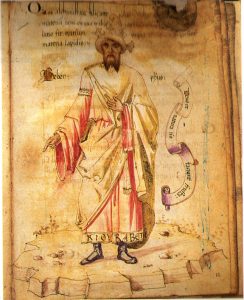
15th century portrait of GeberAfter the fall of the Roman Empire, alchemical development moved to the Islamic World. The roots of Muslim alchemy came from the Greek. Arab scholars saved and preserved the Hellenistic works that were otherwise lost. They translated them, created commentaries on Greek authors and incorporated many of their theories and technical terms into Arabic alchemy works. This extensive writing is why much more is known about Islamic alchemy because it was better documented. This knowledge came partly through direct contact in Egypt, partly through the medium of Syrian Christian translators, and partly by way of Persia. Persian influence is evident through linguistic clues in technical terms and in names of minerals. Noticeably, many of the principal Muslim alchemists were Persians.   The word alchemy itself was derived from the Arabic word al-kīmiyā’ (الكيمياء). 

China

Both the Eastern practice of alchemy and the later Western practice are remarkably similar in their methods and ultimate purpose. Practitioners of both traditions pursued the elixir of immortality  as well as the secret of transmuting one element into another. Turning base metals into gold or silver, was explored by both for obvious reasons.

But because the Chinese approach came from a  basis  in the doctrine of Yin and Yang, Five Phases theory and the I Ching, Chinese alchemy was often more concerned with more philosophical concerns.  It also meant Chinese alchemy was more consistent in its practice from the beginning. There was relatively little controversy among its practitioners. In Europe there were conflicts between alchemists who favored gold-making and those who thought medicine the proper goal. Chinese alchemy was more focused on the medical aspect.

You can see from these examples the common threads that connect the practice of alchemy throughout the world. And from it’s roots in medicine and philosophy, we can derive a practice adapted for our current needs and beliefs. What remains of alchemy after the gold making efforts have died are rich traditions that can still be mined to help personal transformation.

Personal Alchemy for a New Year

Water - Personal AlchemyToday if alchemy is familiar to people at all, it’s usually from Nicholas Flamel’s inclusion in the Harry Potter saga. I was fascinated by alchemy long before Harry Potter and the Philosopher’s Stone. While I never believed you could turn lead into gold or really wanted to, I did find the history of the subject fascinating. So many colorful characters, including the Nicholas Flamel mentioned in Harry Potter.  Alchemy was not only the forerunner of modern chemistry but contains much of philosophy and spiritual thought. It can serve as a basis for individual transformation through the practice of personal alchemy. Many years ago I went to a Barnes & Noble with my friend Maryann and found a book that I had to take a look at, Alchemical Psychology by Thom F Cavelli PhD. While Maryann perused the books she had chosen to look at and we drank our coffee I dove into the book. It was a fascinating application of the alchemical arts as personal alchemy and so interesting I bought it. I recently pulled it out to revisit for my winter reading list and made a decision. This will be my year for a transformation by personal alchemy.

The combining of alchemical thought and psychology was new to me when I first saw the book, but the author was far from the first to examine this. In alchemy the main object is the Magnum Opus or Great Work. This was initially considered the complicated process of creating the philosopher’s stone, which could transmute base elements into gold, but later was applied to the perfection of the self as well. Carl Jung is credited with rescuing the idea that the work of transubstantiation also represented a symbolic process of bringing the inner and outer worlds of man into harmony and wholeness. The self improvement section of any bookstore or library will tell you, while alchemy is no longer a common practice, many people are still actively interested in working to better themselves.

The Knight's Dream painting by Antonio de Pereda
The Knight’s Dream Antonio de Pereda [Public domain],

In the winter we are naturally inclined to sleep and sleep leads to dreams. Up until the last few years when health problems disrupted sleep I recalled my dreams almost every night. I would like to recapture that inner exploration. I have begun to dream again quite a bit but recall is very fragmentary. Winter will be a good time to work on that and incorporate personal alchemy into my plans for a better new year. I have been sleeping more quite naturally and starting to remember at least sections of my dreams. Dreams speak to us in symbols and that is also the language of alchemy, especially personal alchemy, as dreams are unique to each individual.

Painting by Joseph Wright of Derby of The alchemist
The Alchemist by Joseph Wright of Derby ,

I am appreciative of the many blessings I have but I also know that it would not take much to loose them. Even in the developed world hundreds of thousands of people, if not millions, are living on the brink of disaster. It might be a flood, tornado or hurricane, but it might also be a lost job or a serious illness. Having only a single source of income is a recipe for trouble. I would like to change this in my own life and for others but it seems very difficult.

Thus the search inside myself for more focus, more determination and more energy. I want to turn the lead in my life to gold. Alchemy is about transformation and I intend to use it as a tool to make my life better, to achieve needed goals and in the process help others to do the same. In his world today you need focus, determination and energy just to get by, never mind get ahead. I want to turn the base metal of stress into he gold of physical energy. doubt, discouragement and depression into confidence, positive thinking and healthy assertiveness. And so he journey begins.